The wrong grease, amount or service interval can turn routine maintenance into unplanned downtime.
Grease is cheap next to a seized bearing, a missed shipment or a weekend spent pulling a gearbox. Getting the selection right keeps maintenance costs predictable and equipment running. This guide covers what red lithium grease is, what the NLGI #1 and #2 grades really tell you, and how to choose between them. Then we look at one specific product, Lubri-Loy 1014L LUBRI-LITH LG, and stick strictly to what has been verified about it.
What is red lithium grease?
A grease is a lubricating oil held in place by a thickener, plus additives. A simple way to picture it is a sponge soaked with oil. The thickener is the sponge. Under load and movement it releases oil to the contact surfaces, then holds it there instead of letting it drain away like a liquid would. That is the main reason grease is used on bearings, pins and bushings that cannot be kept in an oil bath. Our grease vs. oil guide covers that trade-off in more detail.
Lithium greases use a lithium soap thickener. Simple lithium and lithium complex greases are among the most widely used industrial greases because they offer a practical balance of water resistance, mechanical stability and temperature capability for general service. Exact limits vary widely from one formulation to the next.
Color is not a specification
Red is a dye. Manufacturers color grease for identification, so a technician can tell products apart on the shelf or at the fitting. Color says nothing about load capacity, temperature range, base oil or thickener. Two red greases from two makers can be completely different products. Always choose from the data sheet, never by color.
Understanding NLGI grades
The NLGI grade describes consistency, meaning how soft or firm the grease is. It is based on the ASTM D217 cone penetration test: a standard cone is positioned at the surface of a sample that has been worked 60 strokes at 25 °C (77 °F), then released to penetrate under its own weight. The depth is measured in tenths of a millimeter. Deeper penetration means softer grease. The NLGI grade scale runs from 000, nearly fluid, to 6, block-like.
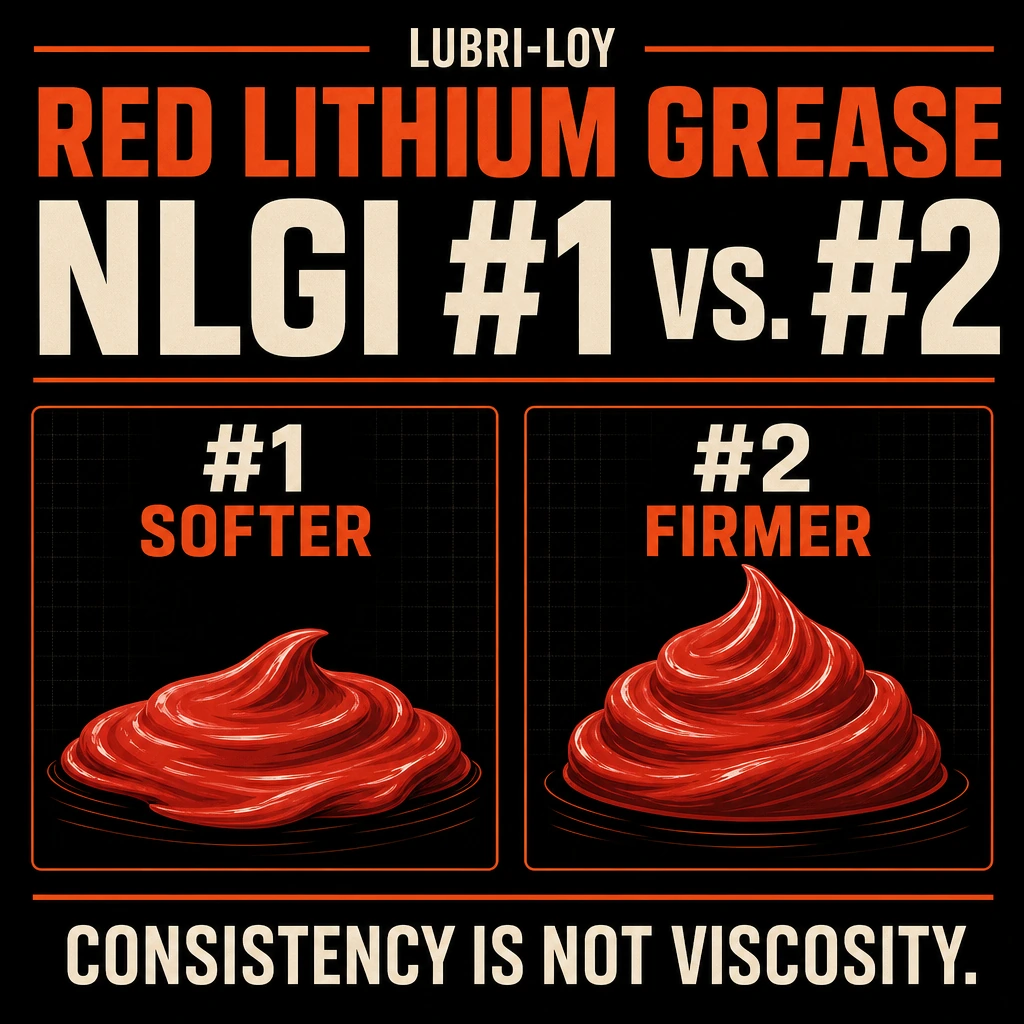
NLGI #1 sits at 310 to 340. In the shop it feels noticeably softer than the familiar #2 cartridge grease. The grade tells you nothing about the thickener, base oil viscosity or additive package. Those are separate decisions.
NLGI #1 vs. NLGI #2
Both grades are common in industry. The differences come down to how the grease moves and how well it stays put.
310-340 (tenths of a mm)
265-295 (tenths of a mm)
Softer. Often compared to tomato paste.
Firmer. Often compared to peanut butter.
Often easier to pump in comparable formulations. Verify low-temperature and delivery-system requirements.
May require more pressure than a comparable #1. Base oil and formulation also affect flow.
Centralized and automatic lube systems, cold-weather service, some enclosed gear and coupling applications.
General-purpose bearings, chassis points and grease-gun service. The most common grade in industry.
May slump or leak from open or vertical points. Confirm the system and OEM call for #1.
May be too stiff for some dispensing systems or cold starts. Confirm the OEM grade.
Penetration ranges per NLGI and ASTM D217. Typical uses are general industry practice, not product claims. The OEM requirement governs.
Where is NLGI #1 lithium grease used?
Softer greases earn their place where the grease has to travel or stay mobile. Common examples include:
- Centralized and automatic lubrication systems with long or narrow lines
- Equipment working in cold weather, where a #2 may stiffen
- Some enclosed gear cases, couplings and slow plain bearings designed for a soft grease
- Applications where the OEM specifically calls for NLGI #1
These are general patterns for the grade, not a list of uses verified for any particular product. Whether a given NLGI #1 lithium grease fits your equipment depends on the manufacturer's specifications and the product's own technical data. For a full framework, see how to choose the right industrial grease.
Introducing Lubri-Loy 1014L LUBRI-LITH LG
- Manufacturer
- The Lubri-Loy Company
- Part number
- 1014L
- Product name
- LUBRI-LITH LG
- NLGI grade
- #1 (per distributor listing)
- Description
- Red lithium grease (per distributor listing)
Lubri-Loy 1014L is LUBRI-LITH LG, NLGI #1, red lithium grease. Lubri-Loy's own safety data sheet covering 1014L lists the product use as industrial grease and the appearance as a red semi-solid. That SDS is a combined document for several LUBRI-LITH LG grades and names the material as a lithium complex grease in grades #1 and #2. It is a safety document, not a performance specification, and its revision date is not legible on our copy.
We could not verify published technical specifications for 1014L, such as base oil viscosity, dropping point, temperature range, EP or load ratings, or approved applications. We are not listing any. Request the current technical data sheet from Lubri-Loy before specifying this grease. Note that the related 2014L is a different, NLGI #2 grade.
Common grease selection mistakes
Overgreasing
Packing a bearing full raises operating temperature through churning and can blow out seals. More grease is not more protection. Follow the OEM quantity and interval.
Undergreasing
Long intervals or short shots starve the contact surfaces. Wear and heat build quietly until the bearing fails.
Mixing incompatible greases
Different thickener systems do not always get along. An incompatible blend can soften and leak out. Purge when switching.
Choosing the wrong NLGI grade
A grease too stiff for an automatic system will not reach the point. A grease too soft for an open bearing will not stay there.
Ignoring OEM requirements
The equipment manufacturer has already weighed speed, load and temperature for that component. Start with what they specify.
How to choose the right industrial grease
A short checklist for technicians, planners and purchasing teams:
- Start with the OEM manual: grade, thickener type and base oil viscosity if listed.
- Match NLGI grade to the delivery method: grease gun, single-line or progressive system, or packed by hand.
- Look at the environment: water spray, dust, heat, cold starts, washdown.
- Consider load and speed. Shock loads and slow, heavy bearings ask more of a grease than light, fast ones.
- Check compatibility with the grease already in service before changing products.
- Review the technical data sheet and SDS, not just the label or color.
- Standardize where you can, and label grease guns and fittings so the right product goes to the right point.
Current safety and technical documents are in our document library. For the basics of choosing between lubricant types, read oil vs. grease: choosing the right lubricant.
Frequently asked questions
What does NLGI #1 mean?
NLGI #1 is a consistency grade. It means the grease has a worked penetration of 310 to 340 tenths of a millimeter when tested by ASTM D217 at 25 °C (77 °F). It is softer than NLGI #2 and firmer than NLGI #0.
What is the difference between NLGI #1 and NLGI #2 grease?
Consistency. NLGI #1 is softer and can be easier to pump than a comparable #2 formulation. NLGI #2 is firmer and widely used for general-purpose service. Neither grade alone establishes pumpability, temperature capability, thickener, base oil or additives.
Why is lithium grease red?
Red is a dye added by the manufacturer for identification. Color does not indicate performance, load capacity or temperature range, and two red greases can be completely different products.
Can I use NLGI #1 grease instead of NLGI #2?
Only if the equipment manufacturer allows it. A softer grease can leak out of seals or run out of vertical bearings where a #2 was specified. Follow the OEM grade first.
Can I mix lithium grease with other greases?
Do not assume compatibility, even when greases share a thickener type. Mixing can cause softening, hardening or oil separation. Check compatibility with the supplier before switching and follow the equipment manufacturer's cleanout or purge procedure.
What is Lubri-Loy 1014L LUBRI-LITH LG?
Lubri-Loy 1014L is LUBRI-LITH LG, NLGI #1, red lithium grease. Lubri-Loy's safety data sheet covering 1014L lists it as an industrial grease with red color. Contact Lubri-Loy for current technical data before selecting it for a specific application.
Where can I buy Lubri-Loy 1014L?
Open the Lubri-Loy 1014L product page. Use Add to cart or Buy now when available, or Request a quote for quote-only products. Direct orders include free shipping within the US.
Conclusion
NLGI #1 and #2 lithium greases cover a large share of industrial lubrication points, but the grade is only the start. The right choice comes from the OEM requirement, the delivery method, the operating environment and the product's own data sheet, not from the color in the tube.
Not sure which grade your equipment needs?
The Lubri-Loy Company has been in industrial lubrication since 1949. Tell us about your equipment, delivery system and operating conditions, and we will help you sort out the requirement. Premium Lubricants, Without Premium Prices.
Sources
- NLGI Grease Glossary: NLGI Grade
- ASTM D217: Standard Test Methods for Cone Penetration of Lubricating Grease
- Lubri-Loy SDS: 1014L and 2014L (archived official source copy)
This article is general education, not an equipment recommendation. Always follow your equipment manufacturer's requirements.